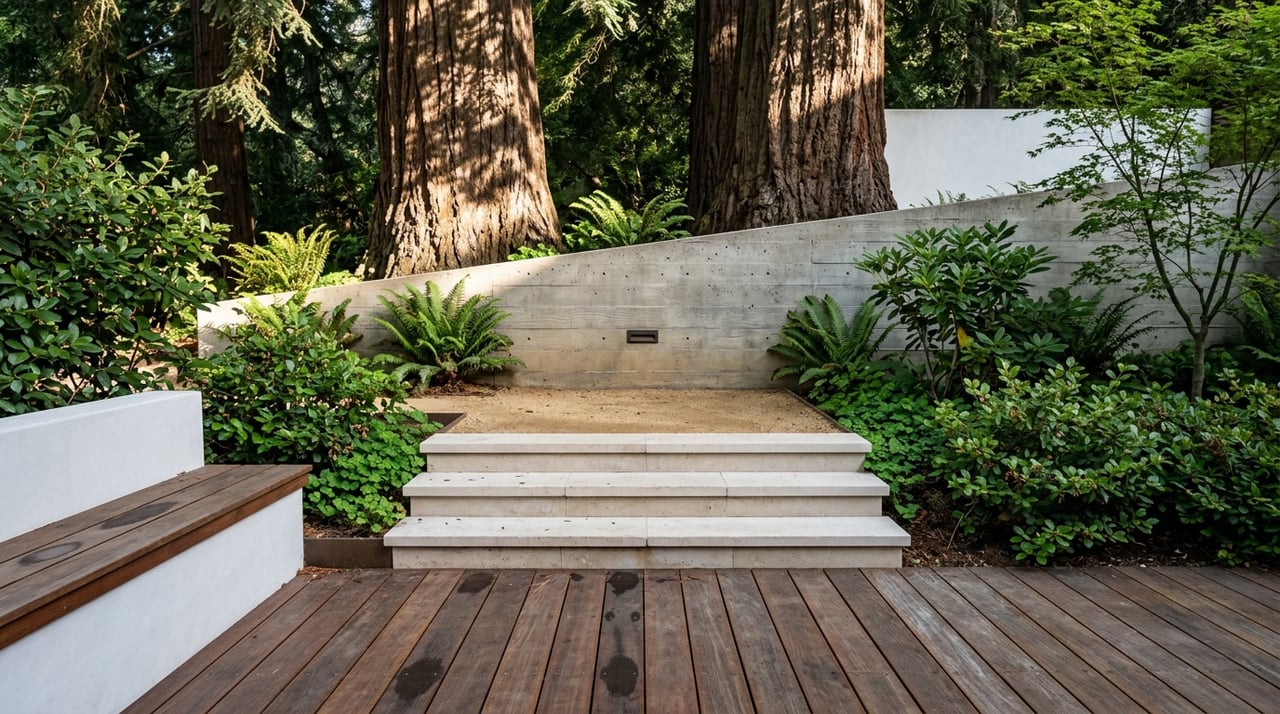
Your outdoor space can add real value to a Mill Valley home, but only when it works with the land instead of fighting it. If you own a property tucked into a slope, shaded by mature trees, or close to a creek or bay edge, you are dealing with the same site conditions that shape much of Mill Valley. The good news is that thoughtful design can turn those constraints into some of a home’s best features. Let’s dive in.
Start With the Site
Mill Valley’s landscape is not flat, uniform, or easy to standardize. The city’s natural environment includes redwood groves, wooded hillsides, ridges, valleys, waterways, and bay marshlands, so outdoor design here often begins with shade, slope, drainage, and view lines.
That matters because a successful yard in Mill Valley usually feels connected to its setting. Instead of trying to create a wide, flat backyard at any cost, the strongest outdoor spaces tend to follow the land and make each level feel intentional.
Design for Hillsides, Not Against Them
Mill Valley’s single-family design guidelines encourage development on sloped lots to step with the terrain, minimize cut and fill, and respect existing topography, vegetation, and drainage patterns. In practical terms, that supports layered outdoor living instead of aggressive grading.
If your lot slopes, think in outdoor rooms rather than one oversized pad. A dining terrace near the house, a small lounge area below, and a path or stair connection through planting can feel more natural and often more useful than a single flattened yard.
Why Stepped Layouts Work
Stepped layouts usually fit Mill Valley lots better for a few reasons:
- They reduce the need for major grading
- They can preserve more of the site’s natural drainage pattern
- They often work better around mature trees
- They can create privacy and separation between outdoor uses
- They reflect the city’s long history of steps, lanes, and paths shaped by steep terrain
Mill Valley’s design history supports this approach. The city notes that its network of steps, lanes, and narrow paths developed as a practical response to hillside conditions, which makes terraced circulation feel especially appropriate here.
Be Careful With Terraces and Retaining Walls
Terracing can absolutely be part of a smart outdoor plan in Mill Valley, but scale matters. The city discourages extensive terracing for large patios or sizable lawns and favors solutions that integrate development with the site more naturally.
When retaining walls are needed, low stepped walls are preferred over one large wall plane, especially where walls are visible from the street. That guidance is helpful even beyond compliance because smaller, layered walls usually look better and feel less imposing.
A Better Approach to Grade Changes
If you are planning a hillside yard, consider these design principles:
- Break elevation changes into smaller transitions
- Use planted areas between terrace levels
- Keep walls visually softer with landscaping where possible
- Avoid creating one oversized platform when several smaller spaces could do the job better
This kind of planning tends to create outdoor areas that feel calmer, more integrated, and more consistent with the home’s setting.
Prioritize Drainage Early
In Mill Valley, drainage is not a finishing detail. The city identifies flooding, sea-level rise, landslides, and mudslides among the hazards that affect the community, and some low-lying areas near the bay can flood.
That means outdoor design should account for water movement from the start. Patios, stairs, walkways, and planting areas all need to support drainage rather than interrupt it.
Materials That Support Drainage
Mill Valley encourages permeable materials when feasible and specifically notes permeable pavers for patios, walkways, and driveways to help reduce runoff and water contamination. On many properties, that makes these materials a practical fit, not just a design choice.
A site-responsive material palette may include:
- Permeable pavers for paths and patios
- Walkways aligned with natural contours
- Landscape areas that help absorb runoff
- Grading plans that avoid sending water toward structures
For more complex hillside work, drainage and engineering review may be part of the process. Mill Valley’s grading permit requirements can include civil sheets, erosion and sediment control planning, drainage calculations, and geotechnical or soils engineering reports.
Decks Can Add Value When They Are Thoughtful
Decks are a natural part of Mill Valley outdoor living, especially on sloped lots where they can create usable space with less land disturbance than heavy grading. The city’s plan-check process covers decks, and local guidelines encourage careful placement.
The key is balance. A deck can open up views and improve circulation, but decks more than 18 inches above finished grade should be located with privacy and noise impacts on neighboring properties in mind.
What Makes a Deck Feel Well Integrated
The most successful decks in Mill Valley often do a few things well:
- They connect directly to interior living spaces
- They fit the scale of the lot and home
- They avoid overexposure to neighboring properties
- They include landscape screening for supports or visible site elements
- They use the deck as one part of a larger outdoor plan, not the entire strategy
This is especially important on hillside sites, where elevated elements can feel visually dominant if they are too large or too exposed.
Protect Trees and Work Around Canopy
Mature trees are one of the defining features of many Mill Valley properties. They also come with real design and permitting implications.
The city requires permits to remove any Heritage tree, four or more non-Heritage trees on a developed site in a year, or any tree from a vacant site. The city also advises applicants to preserve mature trees whenever possible and minimize grading near significant or protected trees.
Design With Trees, Not Just Around Them
A better outdoor plan usually starts by asking how existing trees can shape the layout. That may mean placing a seating area where natural shade already exists, adjusting stairs to protect root zones, or choosing smaller outdoor rooms that preserve canopy rather than clearing it.
From a market perspective, this often helps a property feel more authentic to Mill Valley. Buyers are frequently drawn to homes that feel rooted in the landscape, not stripped of it.
Fire-Smart Design Is Part of Good Design
In Mill Valley, fire-smart landscaping is not optional in spirit, even when owners think of it as maintenance. The city’s vegetation management program makes clear that property owners have a year-round responsibility to keep vegetation from contributing to fire spread.
The city’s home-hardening guidance recommends removing dead plants, leaves, and pine needles within 5 feet of the home and from roofs, gutters, decks, and stairs. It also recommends keeping branches at least 10 feet from roofs and chimneys, moving firewood and propane tanks at least 30 feet away, and keeping emergency access clear.
Outdoor Features That Support Fire Safety
A fire-smart outdoor design may include:
- Hardscape near the home
- Clean, maintained planting beds
- No combustible material under decks
- Ember-resistant deck, gate, or fence choices where attached to the structure
- Thoughtful spacing that avoids ladder fuels
Mill Valley’s guidelines also encourage native vegetation, drought-tolerant planting, and fire-resistant species, while discouraging pyrophytic plants such as acacia, Scotch broom, and eucalyptus.
This approach often aligns with lower-maintenance living as well. That matters in a city that bans gas-powered leaf blowers and increasingly rewards cleaner, simpler landscape upkeep.
Know the Permit Issues Before You Design
One of the biggest mistakes homeowners make is treating outdoor improvements as purely aesthetic decisions. In Mill Valley, decks, retaining walls, fences, pools, and hot tubs can all be part of permit review.
That does not mean you cannot improve your outdoor space. It means the smartest projects begin with a realistic understanding of local review, site constraints, and timeline.
Watch These Common Constraints
Depending on the property, your plan may need to account for:
- Plan check for decks, walls, fences, pools, or hot tubs
- Grading permit requirements for hillside work
- Tree removal permits
- Fence height limits, including 4 feet in front setbacks and 7 feet in side and rear yards in private residential areas
- Creek setbacks on creek-adjacent lots
- Jurisdiction questions if the address is actually in unincorporated Marin County rather than within Mill Valley city limits
For certain named creeks, including Warner Canyon, Corte Madera, Sutton Manor, Old Mill, and Reed, no structures are permitted within 30 feet of the top of bank. If your lot is near a creek, that should be confirmed very early.
Think About Resale While You Design
Outdoor living is emotional, but it is also strategic. In Mill Valley, buyers often respond well to spaces that feel easy to understand, easy to maintain, and clearly suited to the property.
That does not always mean more square footage outside. It often means better planning, stronger flow, and visible signs that the yard has been designed with slope, trees, drainage, and fire safety in mind.
Features Buyers Often Appreciate
In this market, outdoor spaces can feel especially compelling when they offer:
- A natural connection to the home’s architecture
- Multiple smaller-use zones instead of one awkward oversized area
- Materials that support drainage
- Preserved mature landscaping
- Clean stairs and paths that improve movement across the lot
- Fire-smart maintenance and defensible-space awareness
These choices can help a home read as polished, practical, and locally appropriate.
If you are thinking about improving a Mill Valley property before a sale, or evaluating how outdoor design affects value on a purchase, it helps to look at the site through both a design lens and a market lens. That is where thoughtful planning can make a meaningful difference. If you want a strategic perspective on what makes sense for your home, connect with Drew Thomas.
FAQs
Can you add a deck or terrace on a Mill Valley hillside lot?
- Yes, many hillside lots can support decks or terraces, but Mill Valley expects these improvements to relate to the slope, drainage, privacy, and grading conditions of the site and may require plan check.
What outdoor materials work well for Mill Valley drainage?
- Permeable materials are often a strong fit because Mill Valley encourages permeable pavers for patios, walkways, and driveways when feasible to help reduce runoff and water contamination.
Do Mill Valley outdoor projects need permits?
- Many do. The city’s residential plan-check process covers items such as decks, retaining walls, fences, pools, and hot tubs, and hillside grading work may trigger additional permit requirements.
Can you remove trees to improve views at a Mill Valley home?
- Not always. Mill Valley requires permits for Heritage tree removal, for four or more non-Heritage tree removals on a developed site in a year, and for any tree removal on a vacant site.
What makes an outdoor space fire-smart in Mill Valley?
- Fire-smart outdoor design includes keeping the first 5 feet around the home clear of combustible debris, avoiding combustible material under decks, using hardscape near the structure, maintaining vegetation, and keeping emergency access open.
Are there creek setbacks for Mill Valley outdoor structures?
- Yes, on some creek-adjacent properties. Mill Valley states that no structures are permitted within 30 feet of the top of bank along several named creeks, so site-specific review is important.